Why the Photos From Your Staycation Look Flatter Than the Trip Felt

Quick Answer: Staycation photos flatten because home interiors give you low, warm, uneven light and busy, familiar backgrounds — the opposite of the bright, uncluttered conditions that make holiday photos work. The fixes are structural, not sartorial: shoot near a window in the middle of the day, put a plain wall behind you, and choose outfits with a clear tonal contrast against your room rather than against the outdoors.
The weekend was genuinely lovely.
The photos look like you were tidying.
It is not that you dressed badly. It is that your living room is a much harder studio than a beach.
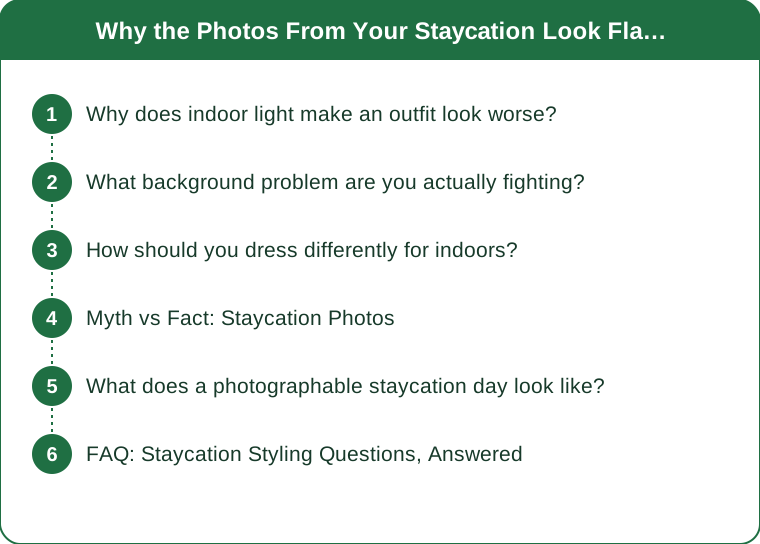
Why does indoor light make an outfit look worse?
Because there is dramatically less of it, and it comes from the wrong place.
A bright outdoor scene might be 10,000 lux or more. A comfortable living room in the evening is often 50 to 200 lux. Your eyes adapt beautifully to that range; a camera does not. In low light, a phone increases sensitivity, which introduces noise, and slows the shutter, which softens edges. Fabric texture — the thing that makes a good outfit read as a good outfit — is the first casualty.
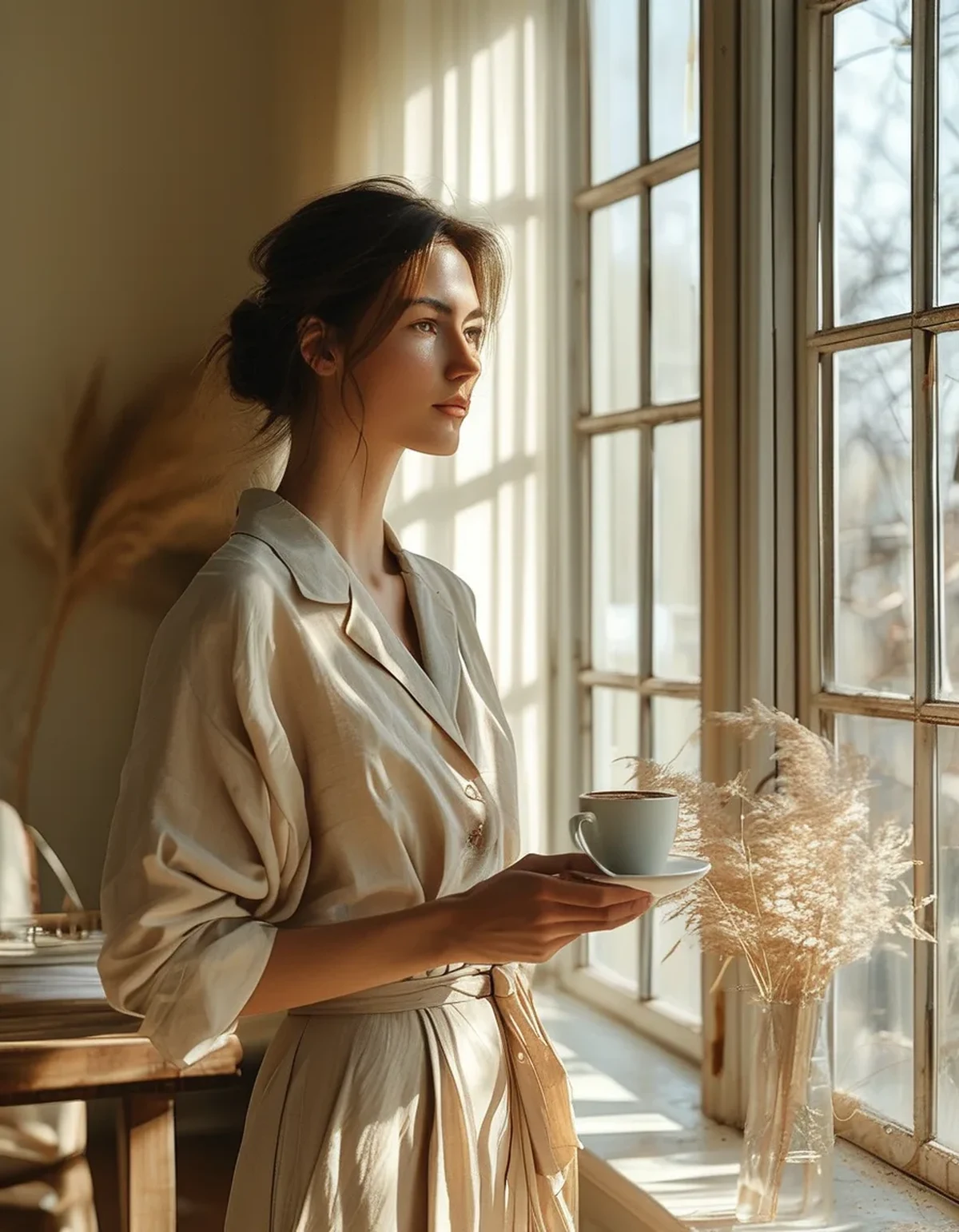
The direction is also unhelpful. Most homes are lit from overhead fixtures, which throw shadows down the face and flatten the front of a garment. Holiday photos are usually lit from a broad sky at a low or side angle, which is naturally flattering.
Add warm bulbs, typically 2700K, and colours shift. A crisp white shirt reads cream, a cool grey reads muddy, and anything you chose for its cool undertone loses the thing you chose it for.
What background problem are you actually fighting?
Familiarity plus clutter.
A holiday background does two things for free: it is visually simple — sea, sky, a plain wall, a wide street — and it is unfamiliar, which makes it interesting. A living room is the opposite on both counts. It has a sofa, a radiator, three cushions, a bookshelf, a charging cable and a laundry basket, all in colours chosen to work together, which means nothing separates you from any of it.
The practical result is that you disappear into your own room. Your outfit is not competing with a plain background; it is competing with eleven other objects in similar tones.
This is why the single most effective change is not a better outfit but a better wall. Find the emptiest vertical surface in your home — often a hallway, a bedroom wall, or the back of a door — and use it as your default backdrop for the weekend.
How should you dress differently for indoors?
Think in terms of contrast with your room, not contrast with the outdoors.
If your home is largely warm neutrals — oak, cream, beige, that sort of scheme — a beige linen set that would look perfect on holiday will merge into the walls. You need either a deeper tone or a clear texture break.
Three things that work reliably indoors:
Texture over pattern. Ribbed knit, cable, corduroy, boucle and heavy cotton all catch low side light and create their own shadows, which reads as depth. Flat prints go muddy in dim light.
A defined shoulder or waist. In low, flat light, silhouette does the work that colour and detail would normally do. A tied waist, a defined shoulder seam or a belt gives the eye a structure to read.
One saturated piece. A single genuinely saturated colour — a deep green, a rust, a proper red — survives warm indoor light far better than a pastel does. Pastels turn to porridge under 2700K bulbs.
Myth vs Fact: Staycation Photos
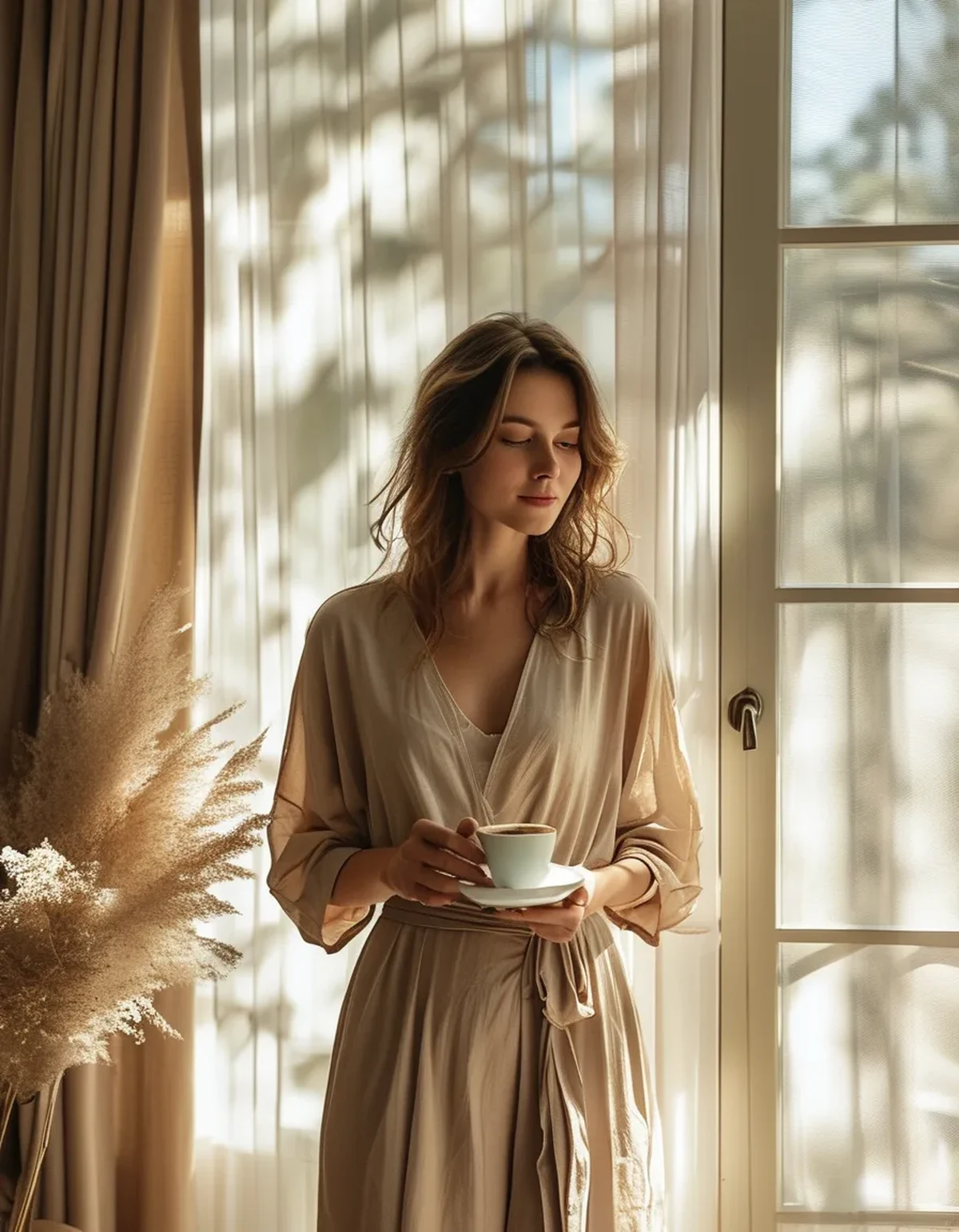
Myth: You need better lighting equipment. Fact: You need a window and a time of day. Mid-morning to early afternoon, standing so the window is at a 45 degree angle to you, beats almost any lamp you can buy.
Myth: Turning on more lamps helps. Fact: Adding warm overhead and table lamps to daylight creates mixed colour temperature, which is the single hardest thing for a phone camera to handle. Skin goes orange in one place and grey in another. Either shoot in daylight or shoot at night with lamps — do not mix.
Myth: The outfit is the problem. Fact: The background is usually the problem. Move two metres to a plainer wall and the same outfit reads completely differently.
Myth: Portrait mode fixes a busy background. Fact: It blurs it, but it also frequently blurs the edge of your hair, your bag strap and one shoulder. It is a patch, not a solution.
Myth: You should dress down because you are at home. Fact: Dressing for the camera and dressing for comfort are compatible. The point of a staycation outfit is that it must survive eight hours of actually being at home, which rules out anything that only works standing up.
What does a photographable staycation day look like?
You do not need to stage anything. You need to make three decisions in advance.
Pick your light window. Decide that the photos happen between roughly 11am and 2pm, when daylight is strongest, and plan the nicest part of the day into that slot — the long breakfast, the balcony coffee, the dressing-up bit.
Pick your two backdrops. One indoors, near your best window with the plainest wall you have. One outdoors — a front step, a balcony, a garden corner, the street outside. Two is enough for a whole weekend and stops every photo looking identical.
Pick a two-outfit day. A soft, comfortable morning outfit and one deliberately assembled afternoon outfit. It is the same logic as a holiday, just compressed. The afternoon outfit is the one that meets the good light.
One genuinely useful habit for late summer: step outside for the photo. Late August evening light arrives at a low angle and is enormously flattering for a good half hour before sunset, and it costs nothing but walking to the door.
FAQ: Staycation Styling Questions, Answered
Should I bother getting properly dressed at home?
If the goal is that the weekend feels like a break rather than a slow Sunday, then yes — the change of clothes is the thing that marks the change of mode. It does not have to mean uncomfortable.
What colours work best in home photos?
Deep, saturated tones and clear texture. Avoid pastels and anything close in tone to your walls or sofa. If your home is warm and neutral, navy, forest, rust and charcoal all separate well.
How do I make the same room look different across a weekend?
Change your angle rather than your room. Shoot from a lower position, from a doorway, or with the window behind the camera instead of behind you. Three angles in one room read as three different places far more than most people expect.
TL;DR:
- Home light is dim, overhead and warm, which flattens texture and shifts colour — the exact opposite of holiday conditions.
- Your background is competing with you; find the plainest wall in the house and make it your default.
- Dress for contrast with your room, favour texture and one saturated piece, and avoid pastels under warm bulbs.
- Do not mix daylight and lamplight in the same shot, and use the 11am to 2pm window for the photos that matter.
The weekend was as good as it felt. The camera just needed slightly more help than the sea would have given it.
Keep Reading
This article is for general informational and styling purposes only. Fit, sizing, and product availability may vary.