Why the Last Staycation of Summer Needs a Completely Different Packing List

Quick Answer: In late August the gap between the coolest and warmest part of the day is roughly twice what it was in July, so pack for range rather than for a temperature. That means one genuine layer per day rather than one outfit per day, closed shoes as well as sandals, and at least one item that works after dark outdoors. The most common late-summer packing mistake is bringing a July wardrobe plus one jumper, which covers the average and fails at both ends.
You packed the same bag you packed in July because it worked in July.
By nine in the evening you were wearing the one cardigan you brought over an outfit designed for thirty degrees, wondering why nothing felt right.
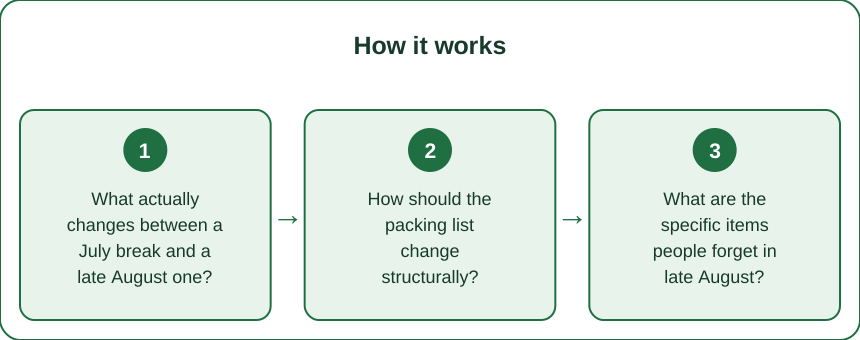
What actually changes between a July break and a late August one?
The daily temperature range widens sharply. Midday can still be genuinely hot while early morning and after dark are ten to fifteen degrees cooler.
Evenings become outdoor-uncomfortable rather than outdoor-pleasant, which changes dinner plans, terrace drinks and anything that runs past sunset.
Sunset moves noticeably earlier, which compresses the warm part of the day and means you are outdoors in cool air more of the time.
Rain becomes more plausible, particularly late in the day, which is a different planning problem from a July heat forecast.
Water is colder - pools, lakes and sea all lag the air by weeks, so swimming is a shorter and colder proposition than the forecast suggests.
And accommodation heating is often not on yet, which is why late-summer rentals can feel cooler indoors than the outside air.
How should the packing list change structurally?
Pack layers, not outfits. One base layer plus one mid layer per day covers a fifteen-degree range where a single outfit covers about five.
Include one warm evening piece that is genuinely warm - a proper knit or a light jacket, not a summer cardigan. This is the single most common gap.
Bring closed shoes as well as sandals. Cool evenings and damp mornings both make sandals the wrong answer, and most people bring only sandals until October.
Add one full-length bottom even on a beach trip, since evenings outdoors need it and a summer bag rarely contains one.
A light waterproof rather than an umbrella, which packs smaller and handles wind, and which you will use more than you expect.
And keep the swimwear - the days are still hot enough, the water is just colder, so a quick-drying towel matters more than it did.
What are the specific items people forget in late August?
A knit that works over a summer dress. Most summer bags contain a cardigan that is decorative rather than warm, which fails the moment the sun goes down.
Socks. A remarkable number of late-summer bags contain none, and then closed shoes become unwearable.
A scarf or light wrap, which is the highest warmth-per-gram item you can pack and doubles as a picnic blanket, a sun cover and an aeroplane layer.
Something with a hood, because late-summer showers arrive faster than you can get anywhere.
A long-sleeved top for insects, which are at their peak in late summer, particularly near water at dusk.
And a second pair of jeans or trousers, because one damp pair with no heating on means a wasted evening.

How do I build outfits from fewer pieces for this weather?
Choose a two-colour base and let everything mix. Neutral bottoms and a single accent colour means every top works with every bottom, which is what makes a small bag feel large.
Every dress needs a layer that works over it, and if it does not have one, it is a daytime-only item and should be counted as half a day rather than a whole one.
Bring one item that changes an outfit completely - a blazer, a good jacket or a distinctive knit - rather than three items that change one slightly.
Repeat bottoms and rotate tops, which is the standard advice because it is the correct advice and halves the volume of a bag.
Choose fabrics that handle a range: cotton, linen blends and fine merino all work across fifteen degrees where a heavy synthetic knit works across five.
And plan the evening outfits first, since that is where late-summer packing fails, then work backwards to daytime.
5 Mistakes That Ruin a Late Summer Break
1. Packing for the forecast high. The forecast high lasts about three hours. You will spend more time in the morning and evening range than in the peak, and packing for the peak means being cold for most of the trip.
2. Bringing only sandals. One cool damp morning and every plan involving walking becomes unpleasant. A pair of closed shoes with actual socks costs almost nothing in bag space and saves days.
3. Assuming the water is as warm as the air. Water lags air temperature by weeks, so late August sea and lake swimming is a colder, shorter proposition than a hot forecast suggests. Bring a proper towel and something warm to put on immediately after.
4. Treating a light cardigan as an evening layer. It is a shoulder covering, not insulation. One genuine knit or light jacket does the job that three thin summer layers fail at.
5. Planning the whole trip outdoors. Late summer weather is more variable than midsummer, and a trip with no indoor alternatives is a trip with a wasted day in it. Have one museum, one long lunch or one indoor plan per three days.
And the bonus mistake: leaving the packing until the night before. Late-summer packing requires a layer you may not have worn since spring, which is the item most likely to still be in storage.
FAQ: Late Summer Staycation Packing Questions, Answered
How many outfits should I pack for a four-day trip?
Think in layers rather than outfits: three bottoms, five tops, two layers and one evening piece covers four days comfortably with room for weather variance.
Is it worth bringing swimwear in late August?
Yes for pools and hot afternoons, with realistic expectations for open water, which is colder than the air suggests. A quick-drying towel matters more than it does in July.
What is the single most useful item to add?
A proper knit or light jacket that works over everything else you packed. It is the item that turns a cool evening from something endured into something enjoyed.
Should I pack differently for a coastal versus a city staycation?
Coastal needs more wind protection and warmer evening layers; cities stay warmer after dark and need more comfortable walking shoes. Both need the closed shoes.
How do I handle the pack-for-rain problem without doubling the bag?
One light waterproof with a hood and one pair of shoes that tolerate being wet. That is the entire rain contingency for a short trip.
Does the packing change for a September trip?
Yes - September tips further, and the evening layer becomes the main layer rather than the backup. Swimwear becomes optional and a second warm piece becomes worthwhile.
TL;DR:
- Late August has roughly double July’s daily temperature range - pack for range, not for a number.
- One genuine warm evening layer, not a decorative summer cardigan, is the item most often missing.
- Closed shoes and socks turn cool mornings and damp evenings from a problem into a non-event.
- Plan evening outfits first and work backwards, since that is where late-summer packing fails.
- Water is colder than the air suggests, so pack a proper towel and something warm for straight after.
A July bag plus one jumper covers the average and fails at both ends.
Keep Reading
This article is for general informational and styling purposes only. Fit, sizing, and product availability may vary.