Why a Staycation Outfit Needs a Weather Plan More Than a Trip Abroad Does

Quick Answer: Packing for a destination works because the conditions are narrow and known — you dress for one climate and one set of activities. A staycation has neither. The weather is unpredictable, the activities range from a garden morning to a restaurant evening, and there is no packing constraint forcing you to decide. The fix is to impose the constraint deliberately.
A week in Spain fitted into a carry-on without difficulty. Four days at home has produced three abandoned outfits before lunch.
The difference is not that home is harder to dress for. It is that nothing forced you to make a decision.

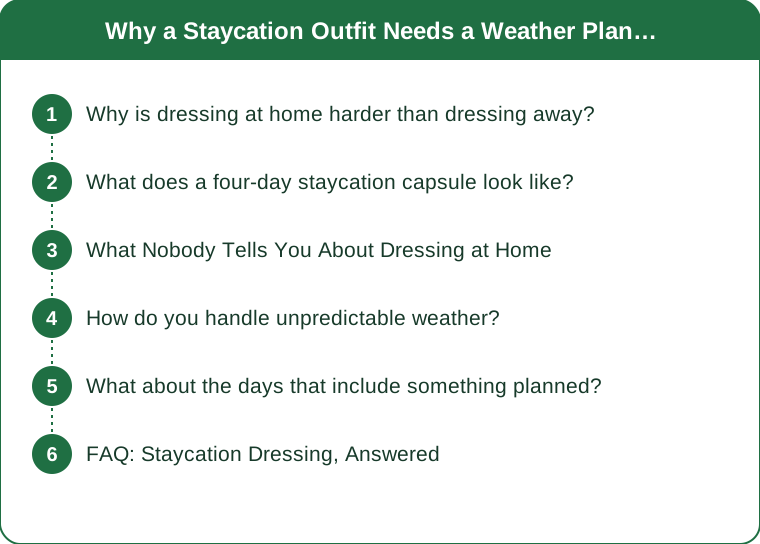
Why is dressing at home harder than dressing away?
Three reasons, and the last is the significant one.
No climate certainty. A destination has a forecast you can plan around. A staycation in a temperate climate can produce four genuinely different weather days in a row, and any given day can move through most of them.
No activity certainty. Trips have itineraries. A staycation typically does not — the day might be a walk, a garden, a museum, a pub, or all of them in an unplanned order.
No constraint. This is the real problem. Packing forces limitation: one bag, so you choose. At home, the entire wardrobe is available, and unlimited options produce worse and slower decisions than limited ones. This is why people who dress themselves competently for a two-week trip stand paralysed in their own bedroom.
The counterintuitive fix is to impose an artificial constraint. Pack a bag for your staycation — physically, into a suitcase or a drawer — and use only that. It sounds absurd and it works, because it reproduces the condition that made packing for the trip straightforward.
What does a four-day staycation capsule look like?
Small, and organised by layer rather than by outfit.
Two bottoms. One that works for anything active or casual — jeans, or a relaxed trouser. One that reads slightly more considered for an evening or a lunch out.
Three tops. One fitted base layer, one relaxed everyday top, one that carries an evening on its own.
Two layers. One warm and casual, one smarter. A knit and an overshirt, or a cardigan and a blazer.
One outer layer appropriate to the actual season, plus a packable waterproof if there is any chance of rain.
Two pairs of shoes. One you can walk several miles in, one for anything else.
That is eleven items and it produces more workable combinations than most people manage from a full wardrobe — because everything in it was chosen to work together, which is the property a full wardrobe conspicuously lacks.
The test for each item: does it work with at least two other things in the group? Anything that only works one way comes out.
What Nobody Tells You About Dressing at Home
The transition from indoor to outdoor is the whole problem. On a trip you dress once and leave. At home you might go out and come back four times, and each transition invites a change. The outfits that work are the ones that survive both environments without adjustment.
Loungewear ruins the day more than people admit. Staying in comfortable indoor clothes until midday reliably delays the point at which the day starts, and there is a consistent reported effect on how the whole day goes. Getting properly dressed early is one of the more effective things you can do with a staycation.
The front-door test is the useful one. Would you answer the door in this? If not, you will change before going out, which means you will not go out spontaneously. Outfits that pass the door test convert into actual activity.
Shoes decide more than clothes. Being in outdoor shoes rather than slippers is what makes leaving the house frictionless. It is a small thing with a disproportionate effect on whether the day contains anything.
You will be photographed more than you expect. Staycations produce photographs at the same rate as trips, and nobody accounts for that when dressing for a day at home.
The evening is where staycations fall down. A day at home builds no natural transition into evening, so people stay in daytime clothes and the evening never feels like one. Changing at six is a small ritual with an outsized effect.
Weather changes matter more, not less, at home. On holiday you commit to the day’s plan regardless. At home, rain means going back inside, which is why a genuine waterproof does more for a staycation than for most trips.

How do you handle unpredictable weather?
Layering, and specifically layering that removes cleanly.
Build from a base that works alone. Whatever you would wear at the warmest point of the day should be the bottom layer, complete on its own. Everything above it is removable.
Mid-layers should fold small. A knit that has to be carried in your arms all afternoon is a mid-layer that will not come off.
Own one genuinely waterproof outer layer. Not water-resistant. The most common staycation failure is a day abandoned to rain that a proper jacket would have made perfectly pleasant.
Choose bottoms that handle a shower. Denim in the rain is heavy and cold for hours. A technical or synthetic-blend trouser dries in minutes and is the item most people do not have.
Have one pair of shoes that can get wet. This is what determines whether a rainy afternoon walk happens.
Check the forecast at breakfast and commit. The tendency at home is to keep options open all day, which results in a day of standing in the bedroom. Deciding at 8am, even on incomplete information, produces a better day than deciding continuously.
What about the days that include something planned?
Build the whole day around the fixed point rather than dressing for the day and adjusting.
If there is a dinner at 7pm, that is the anchor. Choose the evening outfit first, then work backwards: what can be worn during the day that either becomes it or changes into it with minimal effort.
The one-swap principle works well. A daytime outfit that becomes an evening one by changing a single item — shoes, or a top layer — means you are dressed for both from the morning.
Book something on at least two of the days. This is styling advice disguised as scheduling advice. A staycation with no fixed points tends to produce days that never quite start, and dressing follows the same pattern. One booked thing per day gives the day a shape and gives the outfit a purpose.
Treat the first day differently. The transition from working to not working takes a day, and the first day of a staycation is frequently spent doing tasks. Dressing for it as though it is a holiday day tends to fail; dressing comfortably but properly, with the expectation of getting things done, works better.
And leave the house on the first morning, early. The single most effective staycation habit anyone reports. It breaks the association with an ordinary day at home, and it means you are dressed and out before the day has a chance to dissolve.
FAQ: Staycation Dressing, Answered
Is it worth actually packing a bag for a staycation?
Surprisingly, yes, and the people who try it tend to keep doing it. The constraint is the whole benefit — it forces the decisions to happen once, in advance, rather than four times a day. Using a drawer or a rail rather than a suitcase works just as well.
How do I make a home day feel different without buying anything?
Get dressed properly before breakfast, wear outdoor shoes, and change something in the evening. Those three habits account for most of the difference people describe, and none of them require anything new.
What is the single most useful item to own for staycations?
A genuinely waterproof jacket that you do not mind being seen in. It is the item that determines how many of the days involve going outside, and most people own either something waterproof they dislike or something they like that is not waterproof.
TL;DR:
- Packing works because it imposes a constraint; a staycation has none, and unlimited options produce worse decisions.
- Physically pack a small capsule — two bottoms, three tops, two layers, one outer, two shoes — and use only that.
- Build from a base that works alone, with mid-layers that fold small and bottoms that handle a shower.
- Use the front-door test: an outfit you would answer the door in converts into actually leaving the house.
- Get dressed before breakfast, wear outdoor shoes, change something at six, and leave the house on the first morning.
The reason a staycation is harder to dress for than a fortnight abroad has nothing to do with the clothes and everything to do with decisions. A suitcase makes you choose once. A wardrobe lets you choose continuously, which is how four days off turn into four days of standing in front of it.
Keep Reading
This article is for general informational and styling purposes only. Fit, sizing, and product availability may vary.