Why Getting Dressed for a Day at Home Changes How the Day Goes

Quick Answer: Research on enclothed cognition suggests clothing affects behavior through the symbolic meaning we attach to it, not the garment itself. Clothes associated with focused activity prime focused behavior; clothes associated with rest prime rest. The practical version for a day at home: keep the comfort, change the association. Something you’d answer the door in, that you don’t sleep in, is usually enough.
You had a free Saturday and a list of things you were going to do. You stayed in what you slept in, and at 4pm the list looked exactly the same.

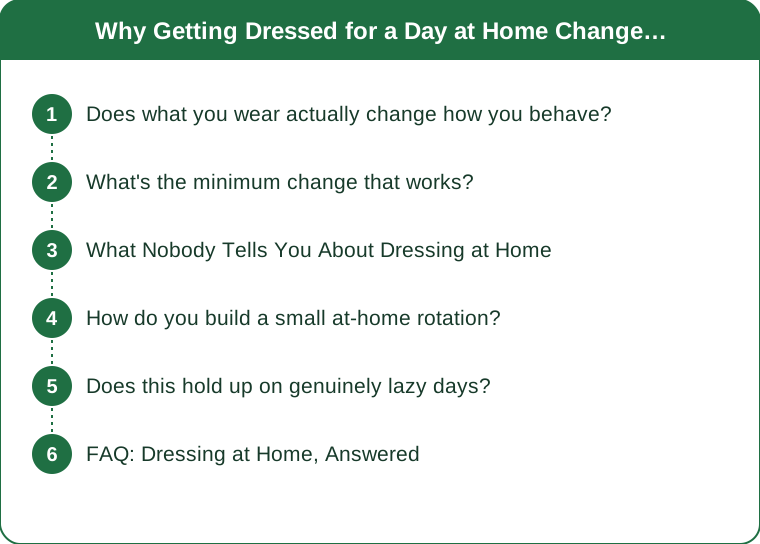
Does what you wear actually change how you behave?
The research suggests yes, with an important qualifier.
The most cited work here found that wearing a coat described as a doctor’s coat improved performance on attention tasks, while wearing an identical coat described as a painter’s coat did not. The garment was the same. The meaning wasn’t.
Subsequent replication has been mixed, as it is with much priming research, so the effect size is genuinely uncertain. What holds up better is the more mundane version: clothing functions as a context cue, and context cues affect behavior strongly and reliably.
This is the same mechanism behind not working in bed. The location carries an association with sleep, which competes with the intention to focus. Clothes work the same way, on a smaller scale.
So the honest framing isn’t “wear a blazer and you’ll be productive.” It’s “the clothes you sleep in are a strong cue for rest, and wearing them all day means fighting that cue for sixteen hours.” That’s a much lower bar to clear and doesn’t require dressing up at all.
What’s the minimum change that works?
Lower than people expect. The threshold is association, not formality.
The working test: would you answer the door in it without hesitating? If yes, it’s crossed the line from sleepwear into daywear, and that’s the whole requirement.
That can be:
- Soft joggers and a clean tee — not the ones you slept in
- A knit set that reads as an outfit rather than pajamas
- Leggings and an oversized shirt
- Any of the above with actual shoes or slippers rather than bare feet
What genuinely doesn’t work is staying in the exact garments you slept in. It’s not about the fabric or the comfort level — it’s that those specific items carry the sleep association.
The second lever is the transition itself. Changing clothes marks a boundary in time, which is the thing a day at home most lacks. Without a commute or a schedule, days blur. Getting dressed is a five-minute ritual that says the day has started, and rituals are how humans mark transitions.
So: same comfort, different garments, and treat the change as the signal rather than the outfit as the goal.
What Nobody Tells You About Dressing at Home
The mirror check matters more than the outfit. Looking at yourself once, deliberately, does more for the effect than the specific garments. It’s the moment of registering yourself as someone in the day.
Shoes change posture measurably. Bare feet at home aren’t a problem, but if you’re going to be on your feet, supportive slippers or house shoes affect how long you’re comfortable standing — which affects whether you actually do the standing-up tasks on your list.
Fabric weight affects alertness through temperature. Heavy fleece raises skin temperature and mild warmth genuinely promotes drowsiness. If you’re trying to focus, lighter layers you can adjust work better than one very warm one.
The second outfit change is underrated. Changing again in the early evening into something explicitly restful marks the end of the working part of the day. Two changes beats one, and it’s the closest thing to a commute you can create at home.
Buying “home clothes” is often unnecessary. Most people already own things that pass the door test and simply default to the softest available option. This is usually a decision problem, not a wardrobe problem.
It stops working if you never leave the house at all. No amount of dressing compensates for zero change of environment. A ten-minute walk does more than any outfit, and doing both is why getting dressed helps in the first place — it makes leaving frictionless.

How do you build a small at-home rotation?
Five pieces, mixed, cover a couple of weeks without thinking about it.
Two bottoms: one soft-but-structured — joggers with a real waistband, or a knit wide-leg — and one legging or slim knit pant.
Two tops: one relaxed long-sleeve or knit top, one simple tee or tank that layers.
One overpiece: a cardigan, open knit, or soft overshirt. This is the item that does the most work, because it converts anything under it into an outfit and it’s what you throw on to answer the door or step outside.
Plus: house shoes and, separately, dedicated sleepwear that you don’t wear during the day. That last part is the actual mechanism — the boundary only exists if there’s something on the other side of it.
On color: a small rotation works better in a coordinated palette, because everything combines. Two neutrals and one accent means all combinations work and you never make a decision.
On cost: none of this needs to be new. The rotation is about designating pieces as daywear rather than acquiring them. Pull five things you already own, put them in a separate part of the drawer, and the system exists.
Does this hold up on genuinely lazy days?
It should bend, and knowing when is part of using it well.
A deliberate rest day is a legitimate thing, and the point of understanding the mechanism is being able to use it in both directions. If you want a low day, staying in soft clothes is a reasonable way to signal that to yourself. The problem isn’t comfortable clothes; it’s comfortable clothes on a day you intended to be different.
The failure mode is the unchosen version — where the day drifted rather than being decided, and by evening there’s a low-grade dissatisfaction that isn’t really about the clothes.
The practical rule: decide in the morning which kind of day it is. If it’s a rest day, stay in the soft thing on purpose and enjoy it. If it’s a doing day, spend the five minutes.
What this reframes is the guilt. Getting dressed at home isn’t a discipline test you’re failing on the days you don’t. It’s a lever, available when you want it, and the main cost of not knowing about it is spending Saturdays disappointed for reasons that felt mysterious.
And on the doing days, it’s genuinely one of the cheapest interventions available — five minutes, no purchase required, and the effect shows up within the hour.
FAQ: Dressing at Home, Answered
Do I need to wear jeans or something structured?
No. The requirement is that the item isn’t associated with sleep, not that it’s uncomfortable. Soft, structured pieces meet the bar completely — the door test is the standard, not formality.
Does this apply to working from home?
More strongly, because the boundary problem is worse when work and rest share a room. The two-change approach — dressed in the morning, changed again at the end of the working day — is what most people who work from home successfully end up doing.
What if I’m home sick or genuinely resting?
Then rest, properly. The mechanism cuts both ways, and using sleep-associated clothing to support actual rest is using it correctly. This is a tool for days you want to be different, not a rule for every day.
TL;DR:
- Clothing works as a context cue; sleepwear cues rest for as long as you’re wearing it.
- The threshold is low — anything you’d answer the door in clears it.
- The act of changing marks a transition, which is what unstructured days lack.
- Five designated pieces you already own is the whole system; a second change in the evening doubles the effect.
Decide in the morning what kind of day it is. Then dress for that one on purpose — including the days when the right answer is the soft thing.
See It in Motion
Seen here: Super High Waist Embossed Yoga Leggings with Inner Pocket — shop it on bubblelime.com
Keep Reading
This article is for general informational and styling purposes only. Fit, sizing, and product availability may vary.