Should You Wear Shoes at Home During a Staycation?

Quick Answer: Not outdoor shoes — but something structured on your feet does measurably change how a day at home goes. Supportive house shoes or a firm slipper give you the postural and psychological cues that bare feet and soft slippers do not, which is why people report getting more done in them. The practical answer is a dedicated indoor pair with a real sole: comfortable enough to wear for hours, structured enough that your body registers you as dressed.
You are three days into a week off, you have not left the house, and the day has developed a shapeless quality you cannot quite name.
Footwear is a surprisingly large part of this. What you have on your feet is one of the strongest signals your body uses to categorize what kind of day it is — and the mechanism in the third section explains why the slipper version of a staycation so reliably slides into a nap.
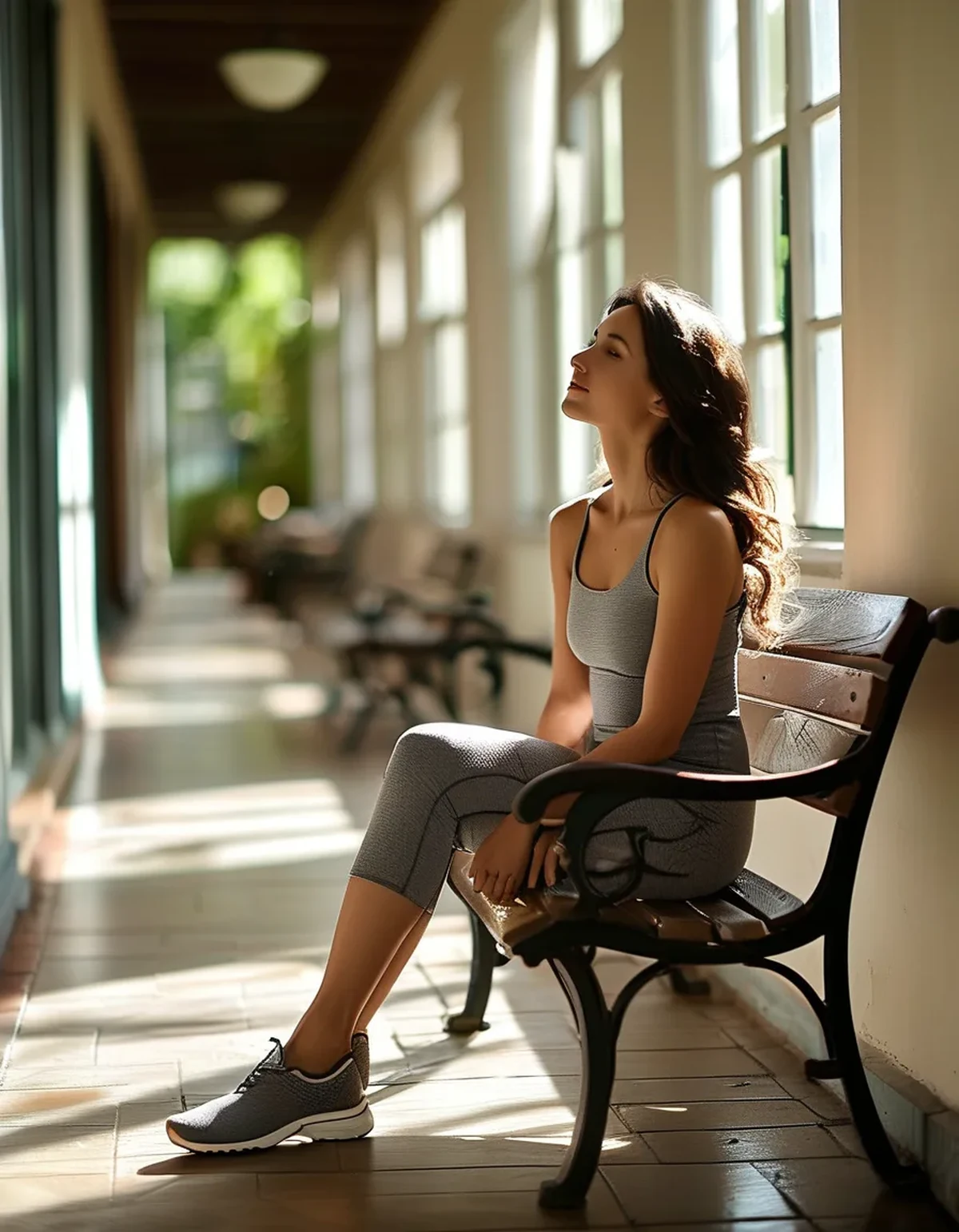
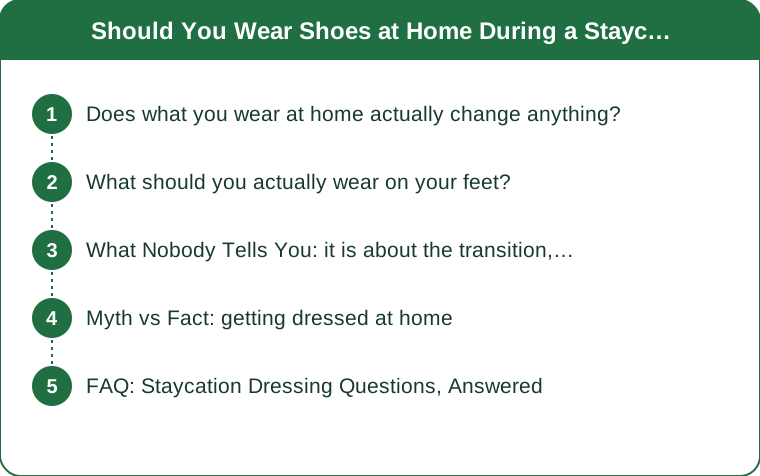
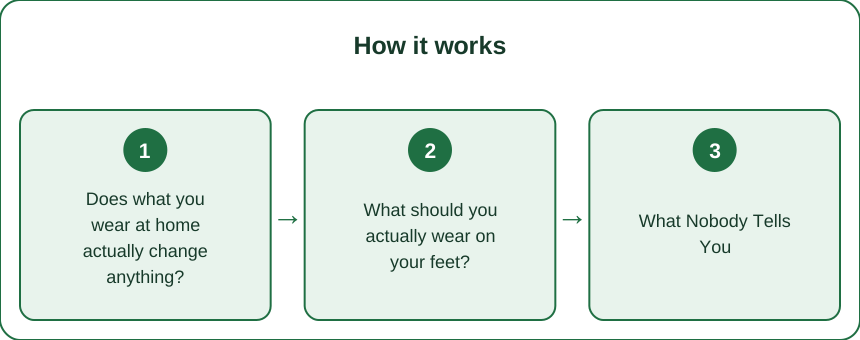
Does what you wear at home actually change anything?
There is a reasonable body of work suggesting it does, though the effect is modest and the mechanism is more mundane than the headlines suggest.
The idea is that clothing carries associations, and putting on a garment activates those associations. Research in this area has found small effects on attention and task performance when people wear clothing they associate with focused work.
The stronger and better-established effect is about transition. A day at home has no commute, no change of building, and no obvious boundary between rest and activity. Getting dressed supplies that boundary artificially, and boundaries are what stop a day from becoming shapeless.
Footwear is the most underrated part of this because it is the piece people skip. You can get fully dressed and still be barefoot, and the day still has a slightly unstructured quality.
There is a physical component alongside the psychological one. Bare feet and unsupportive slippers change how you stand and how much you move. Soft, flat, structureless footwear on hard floors provides no arch support and no cushioning, which for a lot of people means more foot fatigue over a full day and less inclination to be on their feet — and less time on your feet is directly less activity.
What should you actually wear on your feet?
The best option: a structured house shoe
A dedicated indoor shoe with a genuine sole, some arch support, and a closed back. Wool-lined clogs, a moccasin with a real sole, a supportive slide, or a pair of trainers you never wear outside.
The key criteria are a firm sole and a back that holds your heel. A backless slipper changes your gait — you have to grip slightly with your toes to keep it on, which is subtly tiring over hours and is not what you want if you are on your feet a lot.
Why not outdoor shoes
Beyond the obvious hygiene point of tracking what is on the pavement across your floors, outdoor shoes are typically stiffer and less comfortable for eight hours of indoor standing and sitting. The point is structure, not formality.
When barefoot is genuinely better
On soft flooring, for mobility and foot strength, and during any kind of movement practice. There is a legitimate argument that time barefoot strengthens the intrinsic foot muscles, and if your floors are carpeted and your feet are comfortable, this is not a problem to solve.
The distinction that matters is hard floors and long days. Barefoot on tile or hardwood for twelve hours is where foot and lower back fatigue accumulates, particularly for people with flat feet, plantar fasciitis, or any existing foot condition — for whom supportive indoor footwear is often specifically recommended.
The rest of the outfit
Footwear is one signal among several. The broader version: something with structure on top — a real shirt, a knit with shape, anything that is not the shirt you slept in — plus bottoms that are comfortable but not pajamas. The complete pajama day is the version that reliably produces the shapeless feeling.
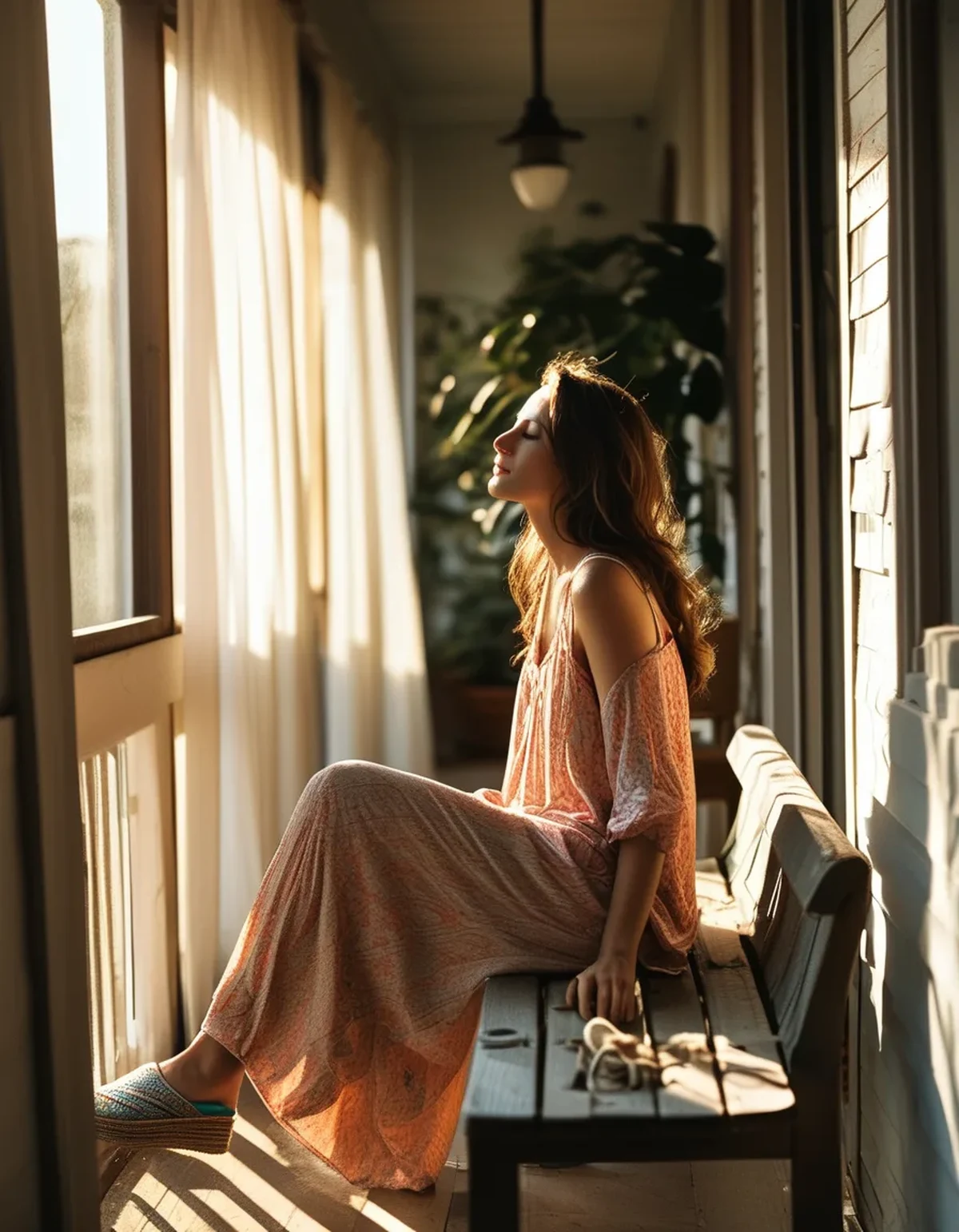
What Nobody Tells You: it is about the transition, not the clothes
Here is the part that reframes the whole question.
The reason getting dressed helps is not that the clothes have properties. It is that putting them on is a transition ritual, and a day at home is missing all of its usual ones.
A normal workday has three or four built-in transitions: getting dressed, leaving the house, arriving somewhere, coming home. Each one tells your brain that a category of the day has ended and another has begun. Remove them all, as a staycation does, and the day becomes a single undifferentiated block — which is why time both drags and disappears.
Footwear is the last item in the getting-dressed sequence, which makes it the natural closing marker of that ritual. That is disproportionately why it works: not because shoes are magic, but because putting them on is the moment the transition completes.
Which suggests the more useful practice. Build two or three transitions into a day at home, and use footwear as the marker for at least one. House shoes on in the morning marks the start. Taking them off at six marks the end. If you want a third, changing tops before dinner does it.
The version that fails is wearing the same thing for eighteen hours, because there is then no moment at which anything changed. People often describe this as a lack of motivation. It is more accurately a lack of punctuation.
There is a seasonal note that matters right now. As it gets dark earlier, the natural light cues that used to mark the parts of the day disappear, and the shapelessness intensifies. Deliberate transitions become more valuable exactly as they become harder to remember to do — which is the reason people find that the reset routine that worked all summer stops working in October.
Myth vs Fact: getting dressed at home
Myth: You have to dress properly to be productive at home. Fact: Formality is not the variable. Structure is. A soft knit with shape and supportive house shoes does the job; a blazer at the kitchen table does not do it better.
Myth: Wearing pajamas all day means you are not taking the time off seriously. Fact: A genuine rest day in pajamas is a legitimate and good use of a staycation. The problem is only when every day is that day and the week ends feeling like it did not happen.
Myth: Slippers are the obvious indoor footwear. Fact: Soft backless slippers are the least useful option for an active day at home — no support, and a gait change from having to hold them on. Fine for the evening, poor for a day when you intend to do things.
Myth: Shoes indoors is a hygiene problem. Fact: Outdoor shoes indoors is. A dedicated indoor pair that never leaves the house is not, and it is standard practice in a lot of households and most of the ergonomics advice for people who work from home.
Myth: This is all placebo. Fact: The psychological effects are modest and the physical ones are not. Arch support and cushioning over a twelve-hour day on hard floors is a real difference in foot and lower back fatigue, whatever you believe about the rest.
FAQ: Staycation Dressing Questions, Answered
What if my home is too warm for closed shoes?
A supportive slide with a firm footbed and a proper sole gives you most of the structure without the heat. The features doing the work are the sole and the arch support, not the coverage.
Should I get dressed even on a genuine rest day?
Pick deliberately rather than by default. A real rest day in soft clothes is restorative. The pattern that leaves people feeling worse is defaulting into it every day without choosing, which is different from choosing it once.
What about the days I have video calls?
Then the top half needs to read as intentional regardless of the rest, and this is the one situation where the specifics genuinely matter to someone other than you. A structured top and a considered background does the work. The house shoes are still for you.
TL;DR:
- Not outdoor shoes — a dedicated indoor pair with a firm sole, arch support, and a closed back.
- Barefoot is fine on soft floors and for movement; it is hard floors over long days that produce the fatigue.
- The real mechanism is transition, not clothing. Footwear works because it closes the getting-dressed ritual.
- Build two or three transitions into a day at home, and add them deliberately as the evenings get darker.
Put them on at nine and take them off at six. It is the cheapest available punctuation for a day that would otherwise be one long sentence.
Keep Reading
This article is for general informational and styling purposes only. Fit, sizing, and product availability may vary.