How to Dress for a Day That Mixes Chores and Actual Rest

Quick Answer: A mixed day needs one base that works for both modes plus one swappable element that signals the switch. In practice that means a structured bottom you can move and kneel in, a layer that comes off for active work and goes on for rest, and a shoe decision — a real shoe for chores, socks or slippers for rest. Changing clothes entirely mid-day almost never happens; changing one layer reliably does.
The outfit’s job is to mark the transition, because nothing else in a day at home does.
This blog has covered why getting dressed for a day at home changes how the day goes, the mistake of treating it as pyjama week, and why your outfit stops working once the house gets cold. This is the mixed-mode version.

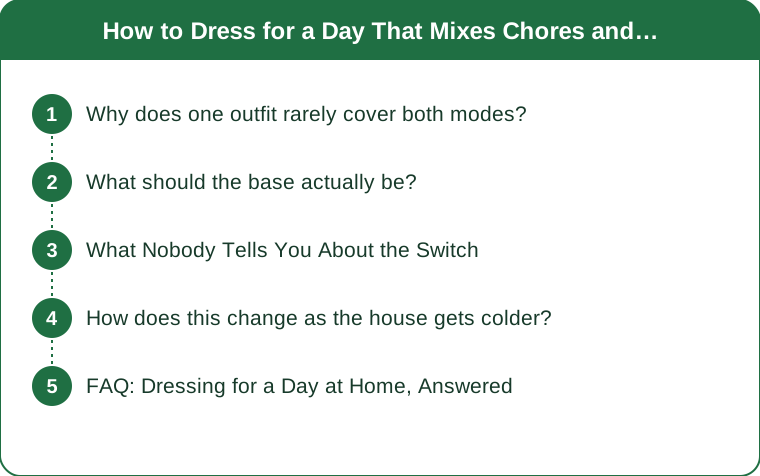
Why does one outfit rarely cover both modes?
Because chores and rest place opposite demands on clothing, and comfort means different things in each.
Chores need movement tolerance and durability. Kneeling, reaching, carrying, bending, and getting wet or dirty are all normal, and they rule out anything delicate or restrictive.
Rest needs softness and low compression. Waistbands, structured seams and anything that presses become noticeable within twenty minutes of sitting still.
A garment optimised for one is usually poor at the other. Proper trousers are excellent for chores and unpleasant to nap in; genuine loungewear is comfortable and utterly wrong for anything requiring effort.
And the psychological function differs too. Chores benefit from clothing that signals doing; rest benefits from clothing that signals stopping.
Which is why the pure-loungewear day so often ends flat. Nothing marked a transition, so neither mode happened properly, and the day reads as neither restful nor productive.
The answer is not two outfits. It is one base plus one signalling element, because a full change requires a decision people do not make mid-day.
What should the base actually be?
Something that meets the chore requirements, because those are the harder constraints.
A mid-weight legging, a soft jogger with a proper waistband, or a knit trouser — anything you can kneel, squat and reach in without adjusting.
Avoid a drawstring you have to keep retying. Small annoyances repeated twenty times decide whether you keep the outfit on.
Choose something you do not mind marking. If you are protecting the garment, you will avoid the chores, and this is a genuine and underrated effect.
A fitted top rather than an oversized one. Oversized tops get in the way of everything — sleeves in the sink, hems catching on handles — and are the most common single point of friction.
Pockets are worth more than they sound. Phone, cloth, keys — a day of chores without pockets is a day of putting things down and losing them.
And it should be warm enough for standing still. The house is coldest in the places you clean, and an outfit calibrated for activity leaves you cold the moment you stop.

What Nobody Tells You About the Switch
The transition element matters more than the base, and it is usually the smallest item.
A cardigan or a soft overshirt is the ideal switch piece. Off for active work, on for rest, and putting it on is a genuine signal to your own brain that the mode has changed.
Shoes are the strongest signal available. A real shoe or a firm slipper for chores and socks for rest changes how you carry yourself more than any other item.
Do not use a blanket as the switch. It only works in one location and it makes rest a place rather than a mode.
Hair is a legitimate switch too. Tied up for chores, down for rest, and it costs three seconds.
Change the switch element at a specific time, not when you feel like it. “Cardigan goes on at four” is a plan; “when I’m done” means never, because a house is never done.
Add one thing that would be fine if someone knocked on the door. Not for anyone else’s benefit — it is what separates being at home from being unavailable, and it is the difference people describe when they say getting dressed changed the day.
And put the chore clothes away when you switch. Leaving them out keeps the mode live and quietly pulls you back to the list.
How does this change as the house gets colder?
The switch piece has to get bigger, and the base has to be warmer than feels necessary.
Layer over the base rather than replacing it. A warmer base you cannot take layers off is uncomfortable during active work, because chores generate more heat than people expect.
Socks become the whole ballgame. Feet are the first thing to get cold on a hard floor and the fastest fix, and cold feet end a rest period faster than anything else.
A thermal base layer under an ordinary top beats a thick jumper, because it is adjustable and it does not restrict movement.
Keep a second, warmer layer at the rest location so the switch is available without a trip upstairs. The trip is what stops it happening.
Watch the gap at the waist. Reaching and bending during chores opens a gap that a longer top or a higher-rise bottom removes, and it is a much bigger comfort factor in a cold house.
And do the cold chores first. Anything outdoors, in a garage or in an unheated room belongs at the start, while you are already dressed for movement and generating heat.
FAQ: Dressing for a Day at Home, Answered
What should I wear for a day at home that includes both chores and relaxing?
One base that meets the chore requirements — mid-weight bottoms you can kneel in, a fitted top, pockets — plus one switch piece such as a cardigan or overshirt, and a shoe change. Full outfit changes mid-day almost never happen; single-layer changes reliably do.
Does what you wear at home actually affect how much you get done?
It affects the transitions more than the productivity itself. Clothing that marks a change between doing and resting helps both modes actually happen, whereas an all-day loungewear default tends to blur them into a day that is neither.
How do I stay warm at home without wearing a bulky jumper?
A thermal base layer under an ordinary top, proper socks, and closing the gap at the waist with a higher rise or a longer top. Layers you can remove during active chores are better than one thick garment you overheat in.
TL;DR:
- Chores and rest place opposite demands on clothing. Build the base around the chore requirements — those are the harder constraints.
- One switch piece, not a second outfit. A cardigan and a shoe change do the work a full change never actually gets made for.
- Change the switch at a set time. “When I’m done” never arrives, because a house is never done.
- In a cold house, socks and a thermal base layer beat a thick jumper, and the waist gap matters more than you think.
The outfit is not about looking good at home. It is the only thing marking the difference between two halves of the day.
Keep Reading
This article is for general informational and styling purposes only. Fit, sizing, and product availability may vary.